
The Holy Well I’ve Never Visited
On St. Colm Og, a girl with laundry, and the six-mile drive I keep not taking

I have lived most of my life within a few fields of a holy well, and I have never been to it. I spent years abroad, which would sound like a reasonable excuse, except I came back a while ago and I still haven’t gone.
I’ve been to plenty of them on the page. Cait walks past one in the first Ashford Cross book. Her cottage is half an afternoon’s walk from a second, which becomes something of a problem in book two. I built a fictional town on top of a fictional well. I wrote rounds and ribbons and healing water, and in the whole time I was writing it, I never once drove the six miles to the actual well in the next parish over.
The well I mean is St. Colm Og’s, in Loughill. Loughill and Ballyhahill have shared a parish for generations, in the way two neighboring villages eventually grow into one. Colm Og, “Young Colm,” was a hermit saint who kept a small church in the area. His name is on a ruined wall a hundred yards up the hill. His well is down in a glen below it.
It had to be in a glen. That’s part of the story.
The story, the one they tell in Loughill, goes like this. There was a girl, and the girl had a pile of laundry, and she took the laundry to the well instead of taking it down to the river where it belonged. The well went dry the same afternoon. When the neighbors came looking, they found the water had moved. It had come up out of the ground a short way off, lower down, where a girl with a washboard would have to work harder to reach it.
I love the moral of that story. The well has had enough of the girl. It simply walks off.
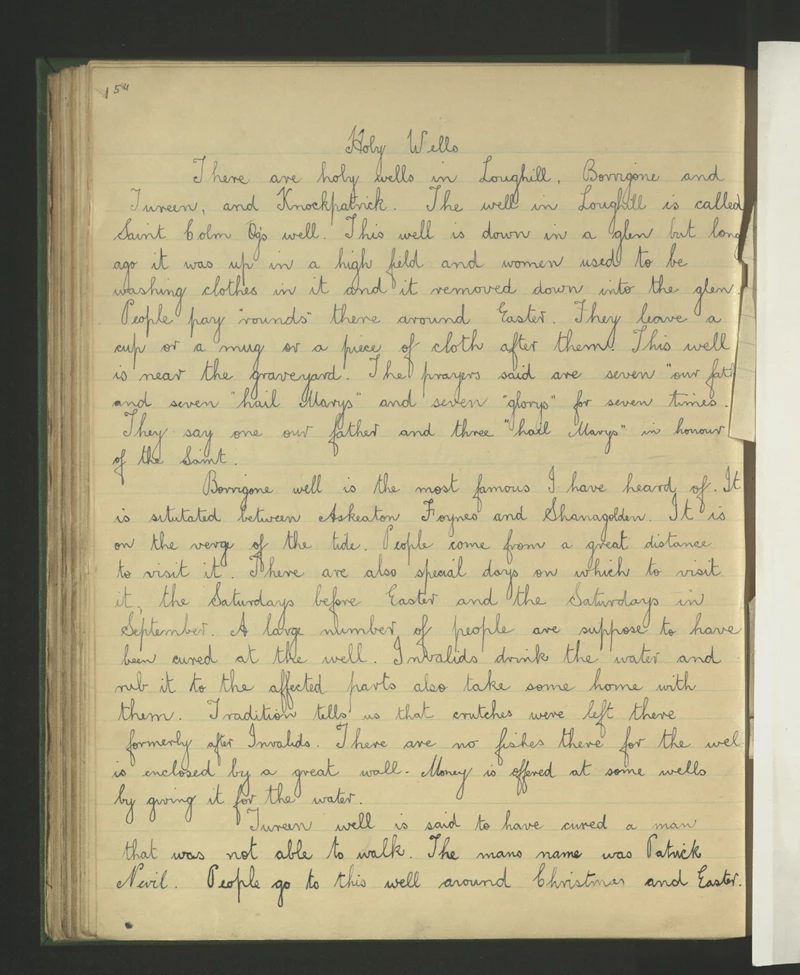
In the Schools’ Collection folklore archive, the one school children filled out in the 1930s, preserving thousands of local scraps that would otherwise have vanished, children from the Ballyhahill school wrote down the rules. You go to St. Colm Og’s well before sunrise or after sunset, never in broad daylight. You walk around it seven times. On each round, you say one Our Father and three Hail Marys. You drop a pebble in after each round, so by the end there are seven pebbles settling at the bottom. And you leave something on the oak tree that shelters the well. A strip of cloth, a ribbon, a child’s sock. Something that belonged to the person you were praying for.
The well is said to cure eye ailments. I read this three times before I accepted it, because it’s so specific. The cure is for eyes, and only eyes. There is something unbearably tender to me about a community deciding that this one spring of water, in this particular glen, is where you go when you are losing your sight.
And I have never been.
I could give you reasons. The real one is that when something sacred is six miles from your house, it stops being a destination. It’s the place at the bottom of the road you’re always driving past on the way to somewhere else. You tell yourself you’ll go on a nice day, or before the tourists find it, or definitely next weekend. And then you write a paranormal cozy mystery about a fictional version of it and feel like you’ve done your homework.
I’m going this spring. I’ve picked a Saturday. I’m not going to do the rounds, because it isn’t my devotion to borrow, and I don’t want to play at being pious for a story. But I want to see the oak and the ribbons. I want to see the water that was so offended by a girl’s laundry that it got up and moved.
I’ll tell you what I find.
Growing up near enough means I know this much already. The well is not a museum. Nobody has put up a sign. Nobody has paved the path or roped off the oak. People visit without fanfare, for reasons they don’t explain to anyone. The ribbons keep appearing and the pebbles stay where they’re dropped. The practice carries on in the margins of ordinary life, while the rest of the parish goes about its Tuesdays.
In a country that has written and filmed and sold its own folklore halfway around the world, the real version of it is still happening down a lane in Loughill, with no one watching, in a place you’d miss if you weren’t looking.
That’s been leaking into Ashford Cross for a while now. The Hedgerow Cafe sits over a well older than its floorboards, and Cait, without quite understanding why, keeps feeling the pull of the ground under her feet. The fictional version is what I could write before I’d been. I’m curious what the real version will do to the next book.
The kettle’s on. Pull up a chair.
— Marian
Every so often I send a letter from the village with folklore finds, writing updates, and the occasional cat-related crisis. You can join the Hedgerow newsletter here.
Originally published on The Hedgerow Post.