
Why a 14th-century manuscript and a 180-foot hole inspired Spirit Elfen
What I found in a Heidelberg library and on a hill near the castle
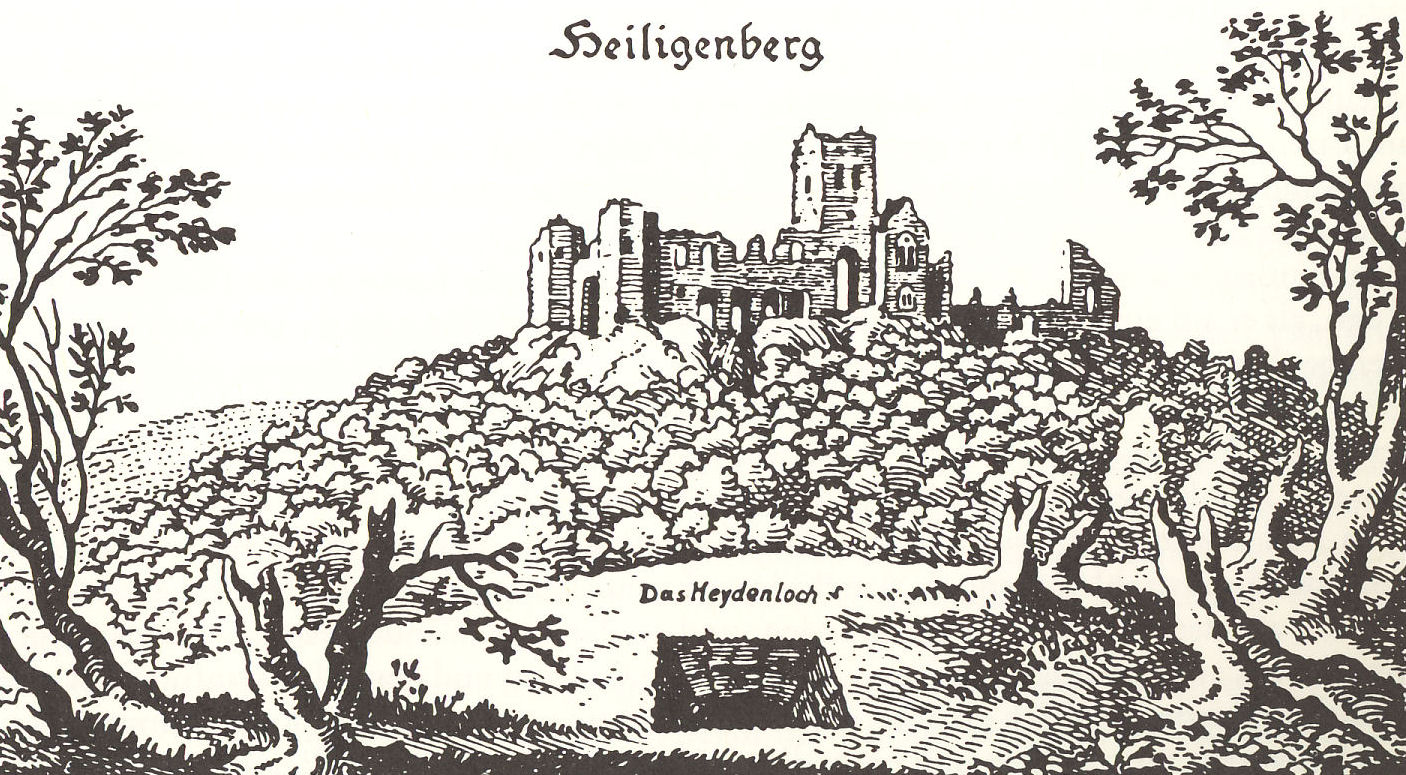
The Codex Manesse is a 700-year-old book of love songs with strange creatures painted across its pages. And the Heidenloch is a pit on a hill outside Heidelberg, Germany, 180 feet deep, dug for reasons that have been lost in time. Both ended up in Spirit Elfen, which I drafted nine years ago after a research dive that was supposed to take a weekend.
Last week on a trip to Germany, I went up the Heiligenberg, looked down into the Heidenloch, and the whole research came back to me. Nine years ago, discovering the Codex pulled me in when I was drafting those parts of Spirit Elfen. Standing at the Heidenloch was a long-held dream, because I haven’t been back to Heidelberg since my student days.
The Codex Manesse
The Codex was put together in Zurich around 1304, commissioned by a family called Manesse who decided to collate all the German love poetry they could find before it disappeared. (Honestly, a fan compilation. The medieval equivalent of making a careful Spotify playlist of every minnesinger he could track down before they were forgotten.)
The result is over four hundred double-sided leaves of Middle High German minnesang, courtly love poems from the mid-1100s through the early 1300s, with 137 full-page miniatures of the poets themselves. Some are kings, some anonymous wandering singers, a handful of them women. The colors are saturated reds and blues that haven’t faded in seven hundred years.
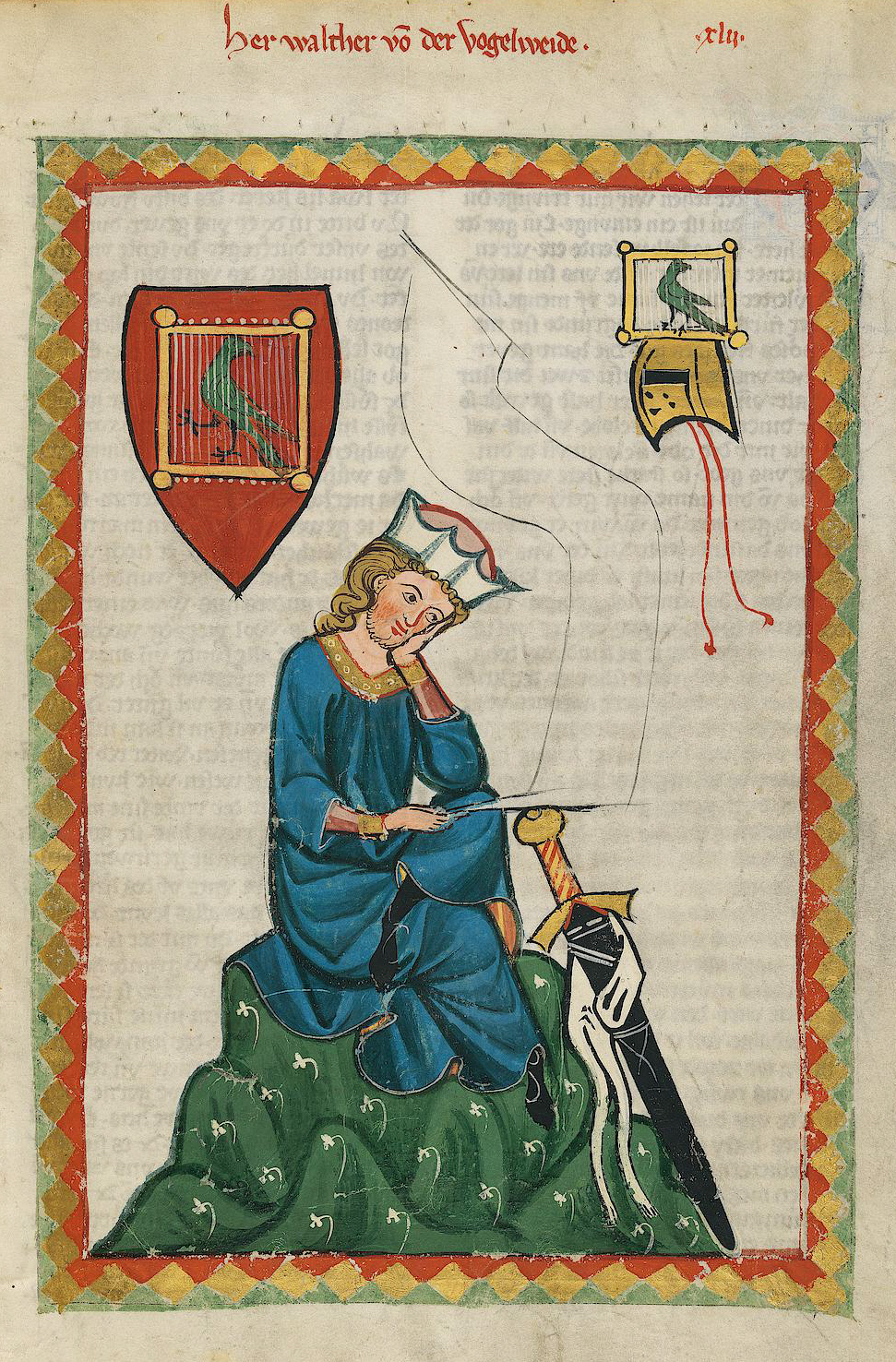
UNESCO gave it Memory of the World status in 2023. It is one of the most beautifully illustrated German manuscripts of its century. I’m certainly not the first writer to be utterly fascinated by this amazing piece of art.
The secondary images tell their own story
What I went looking for, though, was the imagery.
The miniatures are where the painters got weird. The official portraits show poets in heraldic armor, holding shields, looking dignified. The shields and helmets and borders tell another story. Hybrid creatures on shields, beasts with the wrong number of legs, lions wearing crowns, griffins as helmet crests, a man with a falcon and a hare doing something weird to each other.
The medieval imagination was working on more than courtly love, and the Codex is where you can watch it leak out from under the dignified, official portraits. I stared at one folio so long my tea went cold.
These painted creatures do real work. The medieval painter is signaling that the love poem at the center is not the only thing in the world, and the other forces are at the edges. In a manuscript about desire, the painted creatures are where the dangerous parts of desire live. Which, if you’ve read any of my books, you know is a thesis I find hard to walk away from.
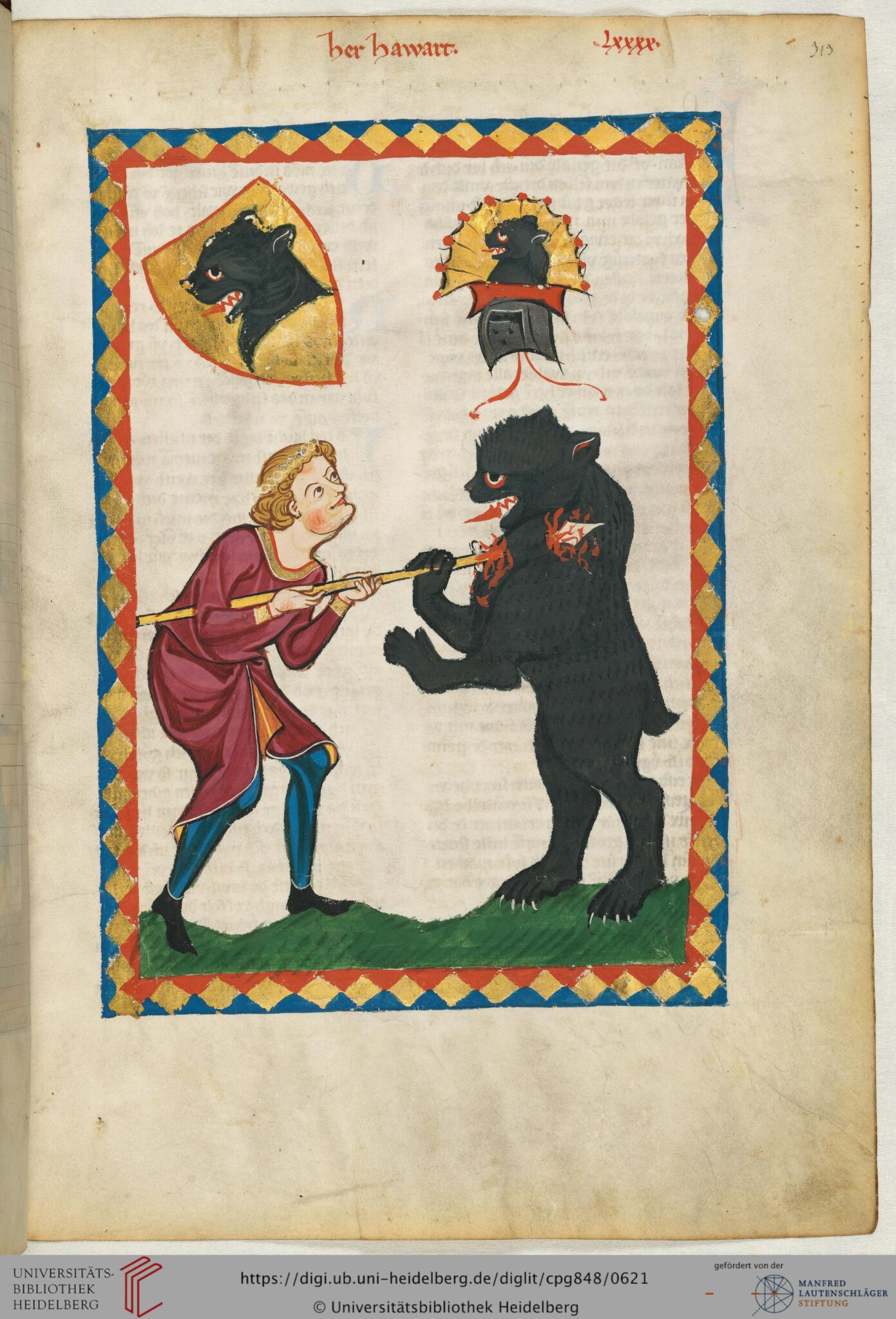
Nine years ago, I sat in front of a digital scan of that folio for an entire afternoon, and the creature ended up in Spirit Elfen.
The Heidenloch
About a mile north of where the Codex now lives, there’s a hill called the Heiligenberg. Saints’ Mountain, though it’s been holy to several different religions over the years. There’s a Celtic hill fort up there older than written history, the foundations of a Roman temple to Mercury, and the ruins of a 9th-century monastery on top of all of it.
And, somewhere on the slope, a vertical shaft 180 feet deep, called the Heidenloch.
Heiden means “heathen.” Loch means “hole.” It is, technically, the heathen hole. Nobody has been able to date it accurately. The leading academic theory says it’s a Roman well or cistern, although the evidence is thin, and other archaeologists argue for Celtic, medieval, or older origins.
It appears in a 1645 engraving by Matthäus Merian, labeled with that name, which means by then it was already old enough that no one alive could explain it. Long before that engraving, the monks who built the monastery on top of it didn’t explain it either. They built around it. (You can imagine the conversation. Brother, what’s the hole? … We don’t talk about the hole.)
Folklore has been less reluctant. The most thorough modern treatment is Heidelberg writer Martin Schemm’s 2017 novel “Das Heidenloch.” The premise is that a fictional 1907 archive documents the Heidenloch’s actual occupants, the man-eating Lästrygonen from Homer’s Odyssey, who allegedly come up out of the hole every hundred years at summer solstice and go hunting in Heidelberg.
The novel is fiction, and the local tradition it draws on is older, with reports of creatures crawling out of the hole after dark and getting into Heidelberg bedrooms, where people woke up gasping for air or didn’t wake up at all. (I am still hunting the primary 19th-century chronicle source. If you know it, write to me and I will cite it properly next week.)
So why is it in my novel Spirit Elfen?
I went up the Heiligenberg this past week. The hole is still there. It’s grated over now, because they don’t want hikers’ dogs falling in, but you can lean on the railing and look down. I went because I wanted to see if the hole was as eerie as I’d described it. Spoiler: it is.
The Heidenloch stars in Spirit Elfen because Honi descends into it. What he finds at the bottom is a legendary baddy, dressed entirely in white, with white hair and white eyes. The entrance to her world has been at the bottom of that shaft for as long as the shaft itself.
The creatures the Heidelberg residents whispered about climb out of the hole after dark. The hybrid thing in the Codex margin, with its too-long neck, its jaw that meets in the wrong place, its eyes set where eyes shouldn’t be set, is one of them. Some 14th-century painter saw it. The monks who built the monastery on top of the shaft pretended they hadn’t. Heidelberg residents in later centuries had stories of their own.
I came along nine years ago, found one piece of evidence in a Heidelberg library and one on a Heidelberg hill, and put them on the same page.
Writers draw their inspiration from the strangest sources. And getting myself hyper on black tea doesn’t help. My husband asked yesterday if I’d considered switching to peppermint. The answer is no, lol.
Want more of this? I send a weekly letter with the stuff I don’t post publicly —deleted scenes, character asides, the occasional emotional wreckage. You can download the first book in the series for free and join the list at the same time.
xo Ella
Originally published on Writing Through the Veil